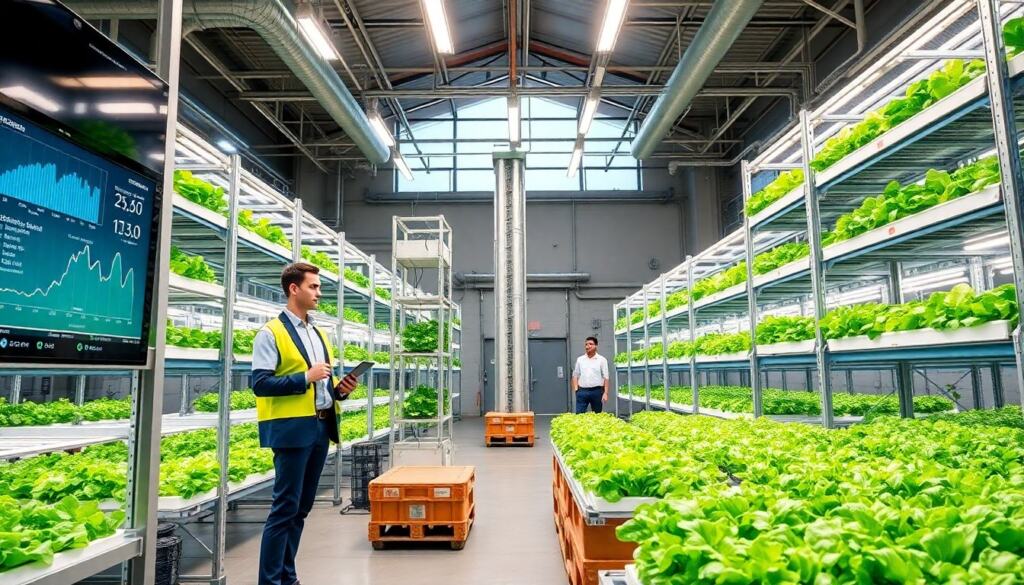
They ask how does vertical farming work as cities push for local food. The article answers how does vertical farming work in clear steps. It shows systems, layouts, and trade-offs. It uses plain language and precise facts. It helps readers decide if they should explore vertical farms in their region.
Key Takeaways
- Vertical farming stacks crop layers indoors using controlled environments to save space and produce food locally year-round.
- Core systems of vertical farming include LED lighting, nutrient-rich water delivery, climate control, and automation to optimize plant growth and reduce labor.
- Growing methods such as hydroponics, aeroponics, and soil differ in water efficiency and crop suitability, influencing yield and energy use.
- Farm layouts typically involve racks, towers, or modular blocks with automated systems that monitor and adjust conditions for optimal production.
- Vertical farming reduces land use, water consumption, and transport emissions but requires significant upfront investment and ongoing energy costs.
- Stakeholders should conduct feasibility studies, considering energy, market demand, and local regulations before adopting vertical farming technologies.
What Vertical Farming Is And Why It Matters
Vertical farming describes a method that stacks crop layers to save horizontal space. Practitioners grow plants in controlled environments inside buildings or containers. Cities adopt this method to shorten supply chains and cut transport emissions. Researchers measure yield per square foot and often find higher productivity than field farms. Policymakers note that vertical farming reduces water use per kilogram. Investors track its capital and energy needs. Many companies plan vertical farms near demand centers to supply fresh greens year-round. Readers ask how does vertical farming work because they want local, reliable produce.
Beyond the core idea of stacking, vertical farming is a systems approach: it combines plant science, engineering, and logistics. Operators design environments at the plant scale (light spectra, nutrient ratios) and at the facility scale (airflow, sanitation, worker flows). That systems view determines which crops make sense, how to control pests without broad-spectrum pesticides, and how to integrate with local distribution channels. Understanding how does vertical farming work therefore means connecting biological needs with machine control and market realities.
Core Systems: Lighting, Water, Climate Control, And Automation
Growers rely on four core systems to run vertical farms. Lighting provides photosynthetic energy. Water systems deliver nutrients and remove waste. Climate control manages temperature, humidity, and CO2. Automation moves trays and tracks plant health.
They use LEDs to supply the right light spectrum for each crop. Engineers tune light schedules to boost growth and reduce power use. They use closed-loop water systems to recycle nutrient solution. Operators monitor pH and electrical conductivity to keep nutrients balanced. They control temperature and humidity with HVAC units and sensors. Automation uses cameras and software to detect pests and nutrient problems. Robotics handle seeding, harvesting, and tray transport to cut labor costs. Planners still ask how does vertical farming work when they choose equipment and layout.
In practice, these systems interact continuously: lighting affects transpiration and thus humidity control; nutrient concentration affects root health and oxygen demand; airflow impacts disease risk. Effective design includes redundancy (backup power, spare pumps), accessible maintenance routes, and integrated monitoring dashboards that combine sensor feeds into actionable alerts. Understanding how does vertical farming work therefore includes both the individual subsystems and the control logic that coordinates them.
Lighting, Nutrient Delivery, And Growing Methods (Hydroponics vs. Aeroponics vs. Soil)
LED lighting replaces sunlight in indoor farms. Engineers set LED intensity and spectrum to match crop needs. Hydroponics uses water to carry nutrients to plant roots. Aeroponics sprays nutrient mist directly on roots. Soil-based systems keep traditional media inside trays.
Hydroponics delivers fast growth and high water efficiency. Aeroponics offers even higher water savings and oxygen access to roots. Soil systems provide buffering and familiarity for some crops. Each method affects yield, energy use, and crop range. Farmers choose methods based on crop type, budget, and skill level. Researchers test lettuce, herbs, and berries across these methods to see which performs best. Buyers often ask how does vertical farming work for each growing method before they invest.
Operationally, choosing a growing method shapes routine tasks: hydroponic setups require nutrient mixing and reservoir management; aeroponic systems need reliable misting nozzles and water quality controls; soil trays require monitoring for compaction and consistent media supply. Crop timing and harvest cycles also vary—the same plant grown in hydroponics may reach harvest size faster than in soil, changing turnover and labor planning. These details are central to answering how does vertical farming work for a particular business model.
Typical Farm Layouts And The Production Workflow
Designers arrange vertical farms in racks, towers, or modular blocks. Racks stack trays in rows to maximize space. Towers use vertical columns to grow climbing or deep-root crops. Modular blocks fit into shipping containers or repurposed warehouses.
They start production with seed selection and propagation in a nursery area. Workers transplant seedlings to trays and place trays into grow racks. The lighting and nutrient systems run on schedules that the control software sets. Sensors collect data on temperature, humidity, light, and nutrient levels. The software analyzes data and sends commands to pumps, fans, and lights. Workers harvest crops on a planned cycle and pack them for local distribution. Managers track yields, costs, and energy use to refine the workflow. Many operators study how does vertical farming work to improve each workflow step.
A practical workflow includes staging areas for incoming materials, quarantine for new plant material to prevent pest introduction, and separate harvest and packing zones to maintain food safety. Logistics planning—how often trucks arrive, how produce is cooled and routed to retailers or restaurants—affects scheduling and product freshness. Facility layout also accounts for human factors: safe access for maintenance, ergonomic workstation design for packing, and clear paths for automated vehicles. These operational choices show how does vertical farming work day-to-day, beyond technical specs.
Benefits, Limitations, And Practical Considerations For Adoption
Vertical farming offers several clear benefits for urban supply. It reduces land use and shortens transport distances. It lowers water use when systems recycle nutrient solution. It gives year-round production that does not depend on local weather.
Vertical farming also faces limits that buyers must weigh. It requires high upfront capital for equipment and space. It consumes significant electricity, mostly for lighting and climate control. It suits high-value, quick-turn crops more than staple grains. Operators need skilled staff for system maintenance and data analysis. Regulations and zoning can restrict farm locations in some cities.
Stakeholders should run a feasibility study before they build. Planners should measure local energy costs and market demand. They should test pilot systems to learn best practices. Investors should compare expected yield against capital and operating costs. Community groups should evaluate local food needs and potential job creation. People keep asking how does vertical farming work because they want clear cost and benefit numbers before they commit.
To move from interest to implementation, a typical adoption path includes: an initial market and site assessment, a small-scale pilot to validate crop performance and energy usage, iteration on systems and layout, and then phased scaling with attention to supply contracts and workforce development. Operators that succeed focus on continuous improvement—tracking yield per square foot, energy per kilogram produced, and customer feedback—to refine both technical and commercial aspects of how does vertical farming work in their context.