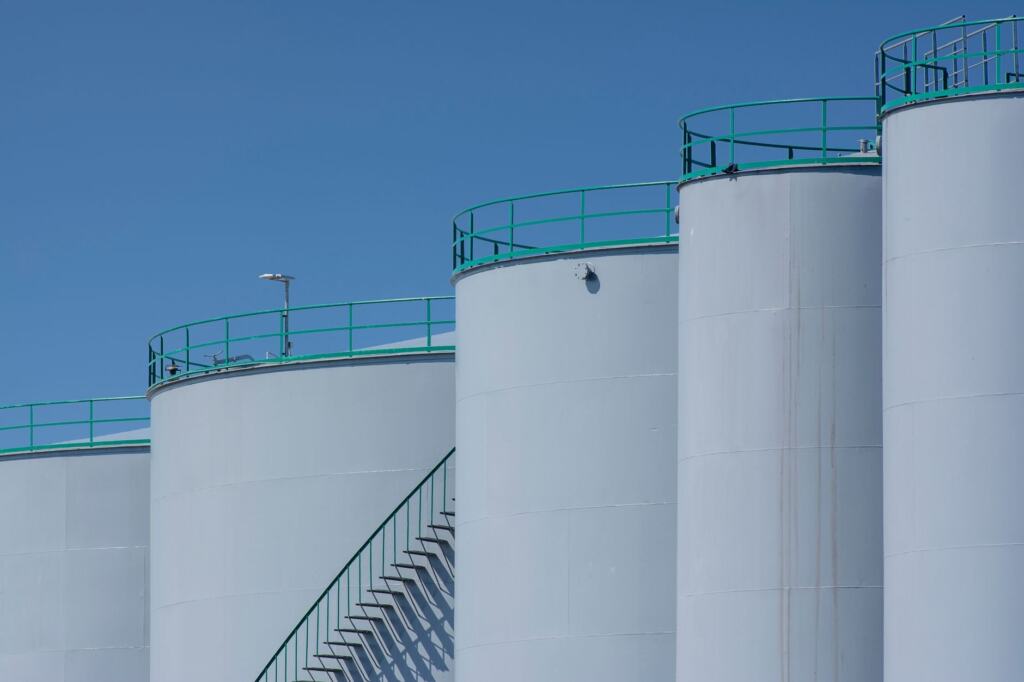
Green hydrogen storage works by compressing hydrogen, liquefying it, binding it into ammonia, or holding it in salt caverns or metal hydrides. Match the method to duration and scale, since the energy penalty and practical size differ by route.
Storage is one piece of the clean-energy picture behind how does biotechnology help the environment. The sections below compare each route on energy cost, safety and use case.
Why hydrogen has to be densified before it is stored
Green hydrogen is made by electrolysis, and the electricity going in is larger than the energy the hydrogen holds. The Kleinman Center for Energy Policy at the University of Pennsylvania notes that hydrogen stores 33.6 MWh of energy per ton, while the best electrolytic production needs about 48 MWh per ton. The Energy Storage Association archive puts conversion efficiency for both alkaline and PEM electrolyzers at about 65%-70% (lower heating value).
Those losses happen before any storage step, so every additional conversion compounds them. The practical rule is to choose the simplest storage form that still meets the duration and scale of the job.
Hydrogen’s physical properties force the engineering choices. It is the lightest element, so it takes up a great deal of space as an ordinary gas. Compressed or liquefied hydrogen has relatively high energy density and chemical stability, which is why those two forms are the usual starting points.
Storage routes from tanks to caverns
Each route trades energy, space and complexity differently. Read the details first, then use the comparison table to shortlist.
Compressed gas in tanks
Storing hydrogen as a gas usually requires high-pressure tanks, typically at 350-700 bar, according to the Fuel Cell and Hydrogen Energy Association. IRENA estimates that compressed gas storage uses about 15% of the hydrogen’s energy content. Small amounts, up to a few MWh, can be held in pressurized vessels. Tanks suit compact sites and short-duration needs where the lowest conversion penalty matters most.
Salt caverns
Salt caverns are created by solution mining, and hydrogen gas is injected into them for long-duration storage. The Energy Storage Association archive describes constructed caverns of up to 500,000 cubic meters at 2,900 psi, equating to about 100 GWh of stored electricity. This is the scale option: nothing else in this comparison reaches the same capacity.
Liquid hydrogen
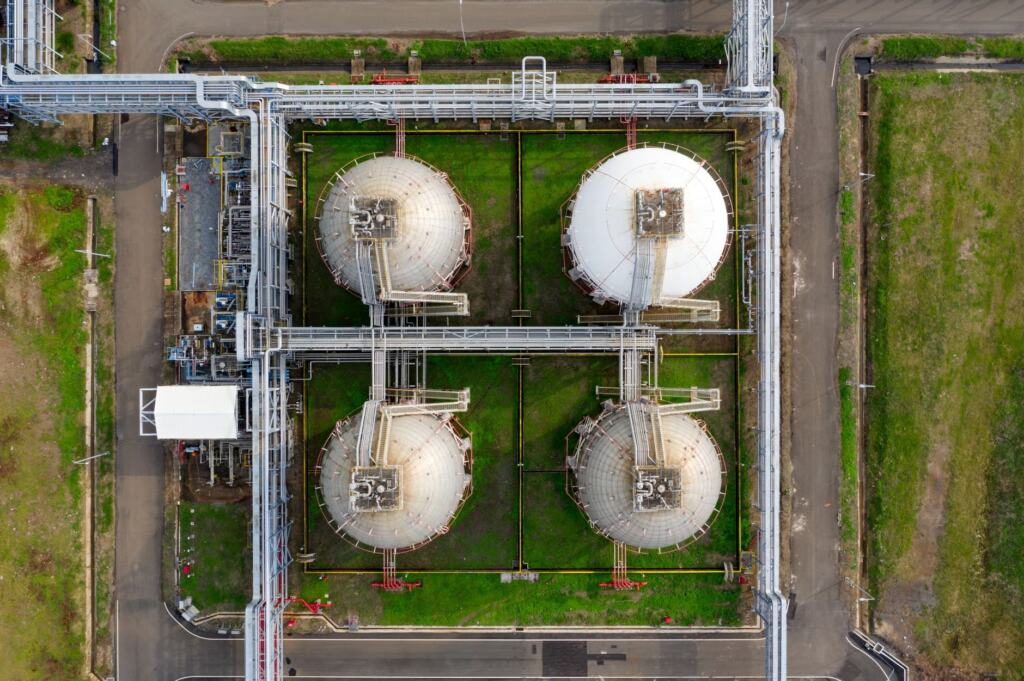
Liquefying hydrogen means cooling it to cryogenic temperatures, below -252.8°C. IRENA reports that liquefied storage has a much higher density than compressed storage. It also estimates that 30-40% of the hydrogen energy content is used in liquefaction. Choose liquid hydrogen only where space or transport volume justifies that penalty.
Ammonia
Ammonia contains 17.8% hydrogen by weight, according to the Kleinman Center. IRENA notes that converting hydrogen into liquid ammonia gives a greater density than hydrogen itself. Ammonia, like liquid hydrogen, requires continuous cooling. It works as a carrier rather than a simple store, so the conversion steps are part of the cost.
Metal hydrides
Solid metal hydrides hold hydrogen at high density and, like pressurized vessels, suit small quantities of up to a few MWh. They fit compact stationary stores, not grid-scale volumes.
| Method | Form and conditions | Key figure | Planning use |
|---|---|---|---|
| Compressed gas | High-pressure vessels | About 15% of hydrogen energy content used; up to a few MWh in vessels | Small sites and short-duration needs |
| Salt caverns | Underground, up to 500,000 cubic meters at 2,900 psi | About 100 GWh of stored electricity | Large, long-duration storage |
| Liquid hydrogen | Cryogenic, below -252.8°C | 30-40% of energy content used for liquefaction; much higher density than compressed | Where volume matters and the cooling penalty is acceptable |
| Ammonia | Liquid carrier with continuous cooling | Greater density than hydrogen | Carrier logistics, not short-duration storage |
| Metal hydrides | Solid-state storage | High density; up to a few MWh | Small stationary stores |
Figures come from IRENA’s liquefied hydrogen storage page and the Energy Storage Association archive.
Safety risks and oversight
The main safety risks of hydrogen storage come from the molecule itself and from the cold or pressure used to densify it. The Kleinman Center states that storing or transporting compressed or liquefied hydrogen will require stringent oversight. Treat the following as design requirements, not options:

- Leakage: hydrogen is the lightest element and escapes even air-tight vessels, so seals, joints and monitoring deserve more attention than they would for heavier gases.
- Embrittlement: hydrogen can embrittle unprotected steel, aluminum and titanium. Specify materials accordingly, and IRENA adds that valves and tanks in liquefied systems must resist hydrogen embrittlement.
- Cryogenic and cooling duty: liquid hydrogen and ammonia require continuous cooling, so a cooling failure is a safety scenario to plan for, not only an efficiency loss.
- Regulatory approval: oversight applies to storage and transport alike, so involve the permitting authority early in site selection.
The US DOE Hydrogen Program covers storage within its research and development remit, which makes it a sound reference point when checking current guidance for a specific design.
Cost drivers and efficiency losses
Storage cost is driven first by how much energy each route consumes. Liquefaction is the clearest example: IRENA’s estimate of 30-40% of the hydrogen energy content compares with about 15% for compressed gas. A liquid system therefore needs a clear reason, such as space or transport volume, to be worth that extra loss.
Ammonia adds synthesis and reconversion steps. The Kleinman Center reports a maximum round-trip return of 52.3% on energy invested for scenarios using ammonia as a hydrogen vector. That is a ceiling for the best cases, not a typical result, so treat it as an upper bound when screening projects.
Caverns offer the largest capacity in the comparison, which is why they dominate large-scale, long-duration discussions. Tanks and metal hydrides stay small, so they carry the smallest absolute stakes.
Choosing a method for grid balancing
Grid balancing splits into short and long duration, and the right store differs. The Energy Storage Association archive notes that hydrogen can level longer periods of deficits or surplus wind and solar output, which is its seasonal and multi-day role. Work through the decision in this order:
- Define the duration. Short cycles favor the simplest store. The Kleinman Center notes that for short-duration storage, the energy demand of ammonia synthesis and cracking far exceeds gas storage in efficiency.
- Match the scale. Vessels and metal hydrides cover up to a few MWh. Beyond that, salt caverns are the route that reaches the GWh range.
- Price the return trip. The Kleinman Center reports round-trip efficiency of approximately 42% for fuel cells and just 17% for hydrogen-powered combustion engines, while the Energy Storage Association archive cites fuel cell re-electrification efficiencies up to 50% and gas combined-cycle burning up to 60%. The first pair measures the whole cycle and the second only the re-electrification step, so compare like with like.
- Confirm safety provisions. Check materials, leak monitoring and cooling before committing to a form.
The practical conclusion: use caverns for large seasonal volumes, compressed vessels for small and short-duration needs, and avoid ammonia for short-duration balancing.
Where hydrogen storage fits in a sustainable system
Hydrogen storage is a clean-energy enabler rather than an end in itself, and it connects to other practical sustainability topics. For land and food systems, see Vertical Farming at Home: A Practical 2026 Guide to Growing More Fresh Food in Less Space – Biolifetechnologies and Regenerative Agriculture Explained: A Practical Definition And Why It Matters In 2026 – Biolifetechnologies.
Frequently asked questions
How is green hydrogen stored?
It is held as compressed gas in tanks, in salt caverns, as liquid hydrogen, converted to ammonia, or bound in solid metal hydrides. Duration and scale decide which fits.
What is the most common way hydrogen is delivered?
The Fuel Cell and Hydrogen Energy Association reports that gas tanker trucks are the most common form of distribution, with interest in liquid hydrogen growing.
How does ammonia infrastructure compare with natural gas?
The Kleinman Center notes the US has just 5,000 km of ammonia pipelines, compared with over 490,000 km of high-pressure natural gas pipelines.
Does the US government research hydrogen storage?
Yes. The DOE Hydrogen Program conducts research and development across hydrogen production, delivery, infrastructure, storage and fuel cells.