| Effect or decision | What the evidence shows | Planning use |
|---|---|---|
| Capture rate | Carbon capture, utilisation and storage technologies can capture more than 90 percent of CO2 emissions from power plants and industrial facilities. | Use this as the upper reference when estimating emission cuts. The remainder is still emitted. |
| Storage retention | At well-selected, managed sites, over 99 per cent of injected CO2 is retained over 1000 years (IPCC figure). | Treat site selection and site management as the condition behind the figure. |
| Energy penalty | A power plant using mineral-storage CCS needs 60–180 per cent more energy than a plant without CCS. | Include the extra energy demand when comparing capture routes. |
| Enhanced oil recovery | Burning the oil recovered this way offsets much or all of the CO2 reduction. | Check the net climate benefit before counting oil-recovery storage as an emissions cut. |
| Retrofit versus new build | Pre-combustion capture is cheaper than post-combustion but cannot be retrofitted to older power plants. | Older plants point towards post-combustion capture. New builds can weigh both. |
| Direct air capture | Capturing CO2 from open air is possible but still being researched. | Treat it as a research-stage option, not a drop-in fix for a plant. |
Figures come from the British Geological Survey (citing the IPCC) and the Center for Climate and Energy Solutions.
Carbon capture and sequestration technology captures CO2 at emission sources, transports it and stores it permanently in geologic formations. Its net benefit depends on the capture method, the energy it consumes and where the CO2 is stored.
For the wider question of how does biotechnology help the environment, the Sustainable Biotechnology hub places engineered capture alongside biological approaches. This guide compares the two and sets out the practical choices for emitters and planners.
What the evidence means for project choices
The headline capture rate is only part of the picture. The net result depends on how much energy the system uses, what happens to the CO2 afterwards and whether the site can be managed for the long term.
- Budget for energy. The 60–180 per cent figure in the table above applies to a power plant with mineral-storage CCS. Capture is not free in energy terms, so compare designs on total energy demand as well as on the share of CO2 removed.
- Be sceptical of oil-recovery storage. The British Geological Survey notes that burning oil recovered through enhanced oil recovery offsets much or all of the CO2 reduction. Projects aimed at climate benefit are better judged on storage in formations that do not produce more fuel.
- Choose sites on retention, not just capacity. The over 99 per cent retention figure applies to well-selected, managed sites. A poorly chosen site cannot claim it.
- Match the method to the plant. A plant that already exists has fewer options than a new build, as the next section explains.
- Keep direct air capture in the research column. It suits organisations tracking emerging options. It does not replace capture at a stack that can already be scrubbed.
Main capture methods and their trade-offs
Capture methods differ mainly in where in the process the CO2 is removed. That position decides whether a plant can be retrofitted, how pure the CO2 stream is and how much energy the process uses.
Post-combustion capture
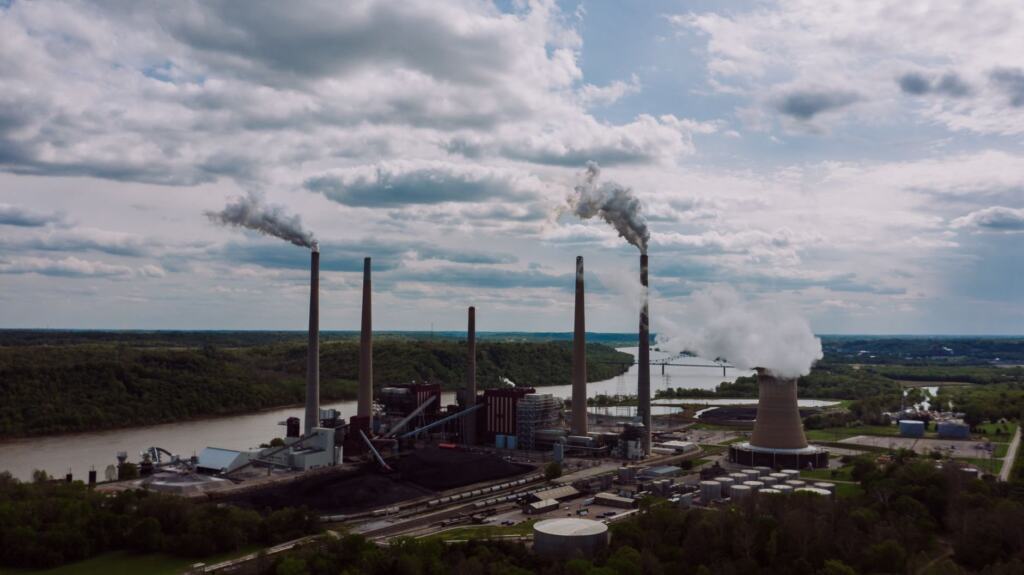
Post-combustion capture removes CO2 from the exhaust, or flue, gases after fuel has burned. It can be fitted to conventional plants, which makes it the practical route for existing assets. The British Geological Survey describes the CO2 as being scrubbed out of the stream leaving the stack. The photograph below shows the kind of multi-stack emission point where this approach applies.
Pre-combustion capture
Pre-combustion capture traps CO2 before the fuel is burned. The fuel is partly burned in a gasifier to make a synthetic gas, and the CO2 is then taken from a relatively pure stream. This route is cheaper than post-combustion capture but cannot be retrofitted to older power plants. It suits new-build projects better than existing ones.
Oxyfuel combustion
Oxyfuel combustion burns fuel in oxygen, so the flue gas is mainly CO2 and water vapour. The British Geological Survey says this may be the most effective of the post-combustion, pre-combustion and oxyfuel methods, but the initial oxygen-burning process is energy intensive. It is worth considering where a very pure CO2 stream justifies the extra energy.
Direct air capture
Direct air capture takes CO2 from the open atmosphere rather than from a stack. The British Geological Survey describes it as possible but still being researched. Because it is not tied to a single emitter, it is a different kind of tool from the three methods above.
How the capture-to-storage chain works
Carbon capture and storage links three stages, and a weakness at any one of them undermines the whole. The US Department of Energy describes the sequence as capturing CO2 emissions, safely transporting them and permanently storing them in geologic formations.
- Capture. One of the methods above separates CO2 from the flue gas, fuel gas or air.
- Transport. The captured CO2 moves to the storage location.
- Injection. For geologic storage, the CO2 is compressed to the supercritical phase, where it behaves like a liquid, and injected into porous rock deep underground.
- Long-term management. Storage performance depends on choosing the site well and managing it, as the retention figure in the table shows.
Is geological storage safe?
Storage is dependable when the site is well chosen and well managed. The British Geological Survey, citing the IPCC, reports retention of over 99 per cent of injected CO2 over 1000 years at such sites. That is a statement about well-selected, managed sites, not a guarantee for every project.
The practical lesson is to judge each project on its geology and management rather than on the technology label. A separate concern is net climate benefit. Storage linked to enhanced oil recovery can leave the overall reduction small, because the recovered oil is burned.
How much does carbon capture cost?
No single cost per tonne applies across methods and sites. Costs are driven by the capture method, the energy the process uses and the storage arrangement. Pre-combustion capture is cheaper than post-combustion but limited to new builds. Oxyfuel combustion may capture most effectively, but its oxygen-burning step is energy intensive.
Public incentives change project economics but are not the same as costs. The US federal credit for direct air capture with saline geologic storage is a credit paid per ton stored, not an estimate of what capture costs, as the questions below explain. When comparing proposals, ask for the capture method, the energy demand and the storage type before comparing headline prices.
Operating projects and scale
Commercial capture exists today, though at a modest scale compared with the emissions it targets. Two reference points show what operating facilities look like.
- Sleipner, offshore Norway. Started in 1996, it was the world’s first geologic storage project, according to the Center for Climate and Energy Solutions. It injects roughly 0.85 million tonnes of CO2 annually, with a cumulative total of over 16.5 million tonnes as of January 2017.
- Shute Creek, Wyoming. The same source describes it as the largest commercial carbon capture facility in the world, with 7 million tons of capacity annually.
Sleipner shows that long-running injection is possible, and Shute Creek shows what capture capacity at the largest scale looks like. Neither figure should be read as typical of a new project.
Can biology help capture carbon?
Yes, but biological approaches work differently from engineered capture. Engineered systems separate CO2 and send it to geologic formations. Biological systems hold carbon in living plants, soils or products. The Department of Energy counts research on plant-associated microbes, or plant microbiomes, and their role in carbon capture among its biological carbon efforts.
Algae are the most direct biotechnology bridge. Researchers are exploring transforming carbon emissions into algae biofuels and building materials, according to the Center for Climate and Energy Solutions. That makes algae a use for captured carbon, not a replacement for geologic storage. The choice between the two follows from the goal: permanent storage points to geologic formations, while products point to biological routes.
For another biotechnology route to lower-impact production, see What Is Precision Fermentation? The Practical Guide to Making Animal-Free Proteins in 2026 – Biolifetechnologies. Pre-combustion capture involves hydrogen-rich fuel gas, and the electrolysis route to hydrogen is covered in Green Hydrogen Electrolysis: How Clean Hydrogen Is Made And Why It Matters In 2026 – Biolifetechnologies.
Frequently asked questions
Do forests and wetlands count as carbon sequestration?
Yes, as biological sequestration. The Department of Energy notes that planting trees and other vegetation removes CO2 from the atmosphere, and that waterlogged bogs and marshlands store carbon by keeping it away from oxygen. The DOE explanation gives no quantity for either.
How many commercial capture projects are operating?
The Center for Climate and Energy Solutions reports 30 commercial-scale carbon capture projects operating around the world, 11 under construction and 153 in development. See the C2ES carbon capture overview for the page’s own wording; it is undated.
Is the US federal credit the same as the cost of capture?
No. The same C2ES page lists a credit of $180/ton for direct air capture with saline geologic storage under the Inflation Reduction Act’s 45Q provision. That is an incentive paid on stored CO2, not a measure of what the capture costs.