| Feature | Supported detail | Planning use |
|---|---|---|
| Infection and developmental disease | A 2016 Nature study reported Zika causing microcephaly by selectively infecting neural progenitor cells | Suits questions about how a virus affects early brain development |
| Protocol choice | 78 of 114 reviewed protocols were guided; 36 of 114 were unguided | Guided protocols are the common route, but unguided ones remain a real option |
| Matrix embedding | ECM embedding appeared in 67 of 114 reviewed articles; Matrigel batch-to-batch variability is linked to higher variability and lower reproducibility | Record matrix batches and expect run-to-run differences |
| Growth time | Mouse organoids complete neuron production in about 9 days; human organoids take over 200 days | Budget long culture runs for human tissue |
| Size and lifespan | About 4 millimeters in diameter; hard to maintain beyond a few months | Expect small, short-lived tissue rather than a whole brain |
The figures come from a Frontiers in Cellular Neuroscience review of brain organoid protocols and a Dong-A Science report on organoid research.
Human brain organoids are three-dimensional clusters of cells grown in vitro that recapitulate aspects of organ structure; they suit disease and development questions, but not studies needing blood supply, immune cells or long-term maturation.
Treat every organoid result as early-stage evidence. Questions such as how do clinical trials work become relevant only when a laboratory finding is considered for patients.
Where organoid results change research decisions
Human brain organoids change research decisions most where animal brains differ from human ones, and where the question concerns early events in human neural tissue.
- Infection and developmental disease. The Zika work is the clearest example. A 2016 Nature study, described in the Dong-A Science report, found that the virus caused microcephaly by selectively infecting neural progenitor cells. A result like this points to a specific cell population, which tells a lab where to look next.
- Species differences. A UC Davis overview notes that using model organisms such as rodents presents clear drawbacks for brain research, because rodent and human brains differ starkly. Organoids built from human cells address that gap directly, which is why they appeal for questions about human-specific biology.
- When to choose organoids. Pick them for questions about early cell-level events, such as which cell type a pathogen infects or how a developmental disorder first shows up in neural tissue.
- When to choose something else. Pick another system when the question depends on blood vessels or immune cells, which current organoids cannot replicate, or when the experiment must run beyond a few months.
These choices rest on what the tissue lacks as much as on what it contains, so the limits deserve their own section.
Limits that shape how to read organoid data
Organoids are simplified tissue, and the simplifications are specific. The Dong-A Science report states that current organoids cannot replicate complex structures such as blood vessels or immune cells, and that they are hard to maintain beyond a few months. The practical consequence is that conclusions about mature brain function, or about effects that only appear over long periods, need extra caution.
Matrix and batch variability
The Frontiers review describes how undefined features, manual embedding and potential Matrigel batch-to-batch variability contribute to higher variability and lower reproducibility between organoids and between runs. For anyone reading or designing a study, this suggests treating a single-batch result as provisional until it repeats across batches. It also makes protocol detail worth checking: the matrix used, how it was applied and how many independent runs support a claim.
Time and scale
Organoid size is modest, about 4 millimeters in diameter according to the Dong-A Science report. That scale, together with the inability to sustain cultures past a few months, bounds the questions a single experiment can answer. Early developmental events fit within those bounds; late-life processes do not.
Ethics and guidelines
The ethical debate around organoids is active but unsettled. The Dong-A Science report describes a growing call among researchers to establish ethical guidelines for organoid research, while also describing the setting of such guidelines as not feasible at present. Human brain organoids are derived from human induced pluripotent stem cells and model features of human neural tissue, so the questions sit close to human biology even though the tissue is small and lacks many brain components.
A sensible reading habit follows from this. When a study makes strong claims, check which cell source and protocol type it used, what the organoids lack, and whether the authors describe their own limits. Absent settled guidelines, transparency in those details is the most practical safeguard a reader can look for.
How brain organoids are made
Brain organoid generation moves human stem cells through staged culture until they self-organize into layered neural tissue. The recipe varies between labs, but the outline is consistent across the literature.
Cell source and stages
Human cortical organoids are derived from human induced pluripotent stem cells (iPSCs), as a EurekAlert news release describes. The Frontiers review outlines the generation sequence for cerebral organoids and related brain organoids:
- Embryoid body (EB) formation in three-dimensional culture.
- Neural induction, which steers the cells toward neural fate.
- Differentiation into neural cell types.
- Maturation, during which the tissue develops further structure.
The timing of these stages differs by protocol and species. The one comparison the evidence supports is that mouse organoids complete neuron production in about 9 days while human organoids need over 200 days, so human runs demand patience and sustained culture care.
Guided or unguided protocols
The review sorts protocols into two families. 78 of 114 reviewed articles used guided approaches, which add signals to push cells toward a target fate, and 36 used unguided approaches that let tissue patterning arise on its own. A UC Davis summary explains that serum-free suspension culture (SFEBq) protocols rely on the self-assembly of stem cells. Guided methods suit a lab targeting a particular region, while unguided methods suit work that values a broader, less constrained mix of cell types.
Embedding and culture handling
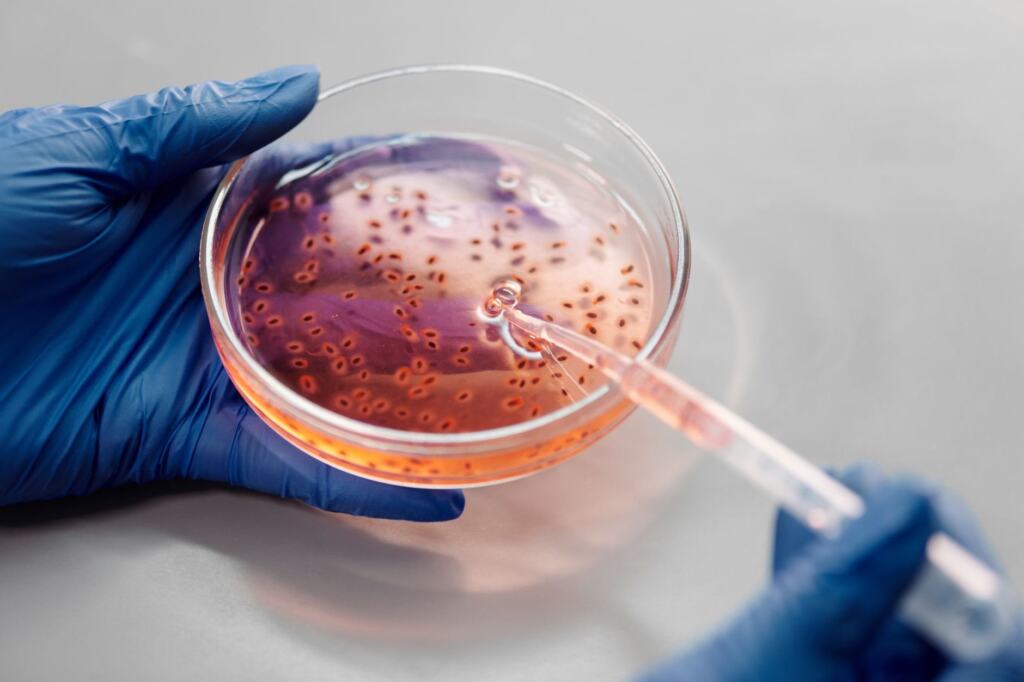
ECM embedding was widely used, appearing in 67 of 114 reviewed articles in the Frontiers review. The embedding step supports three-dimensional growth, and Matrigel is the material whose batch-to-batch variability the review flags. Once embedded, organoids need regular feeding and handling of the culture medium.
Computational companions to organoid work
Organoids are an experimental route into brain biology, and computational methods complement them. Structure prediction is covered in Protein Folding Simulation: How Scientists Predict Structure Faster And More Accurately In 2026 – Biolifetechnologies, and the data side of biology is explained in What Is Bioinformatics? The Practical Guide To Biology, Data, And Discovery (2026) – Biolifetechnologies.
Frequently asked questions
When were 3D cerebral organoids first described?
The first study of 3D cerebral organoids was published in 2013 by Lancaster and colleagues, as recounted in the Frontiers review.
Why do human organoids need so much longer than mouse organoids?
The Dong-A Science report puts mouse organoid neuron production at about 9 days and human at over 200 days. The report gives the figures but not a mechanism, so the practical lesson is to plan human experiments around long culture periods.
Can organoids be studied with implanted sensors?
Yes. A EurekAlert news release on human cortical organoids describes chronic multimodal implant experiments that continued for 11 weeks.