A lab holds a new amino acid sequence but no solved structure. Protein folding AI can predict the shape from that sequence, with per-region reliability scores, though predictions remain hypotheses that experiments test.
The biology behind the problem is laid out in What Is Protein Folding? A Clear Guide To How Proteins Get Their Shape In 2026 – Biolifetechnologies. This guide covers the prediction side: how the method works, how it is scored, how the main models compare and where the limits sit.
How protein folding AI predicts a structure
A protein’s biological function is determined by its three-dimensional native structure, which is encoded by its amino acid sequence, as a Frontiers in Artificial Intelligence review explains. Proteins are built from 20 types of amino acids commonly found in nature. Structure prediction asks the model to turn a linear string of those building blocks into a shape.
Why brute force fails
The Lasker Foundation notes that sampling all possible arrangements of a chain would take longer than the age of the universe, even for a modest-sized protein. The Frontiers review puts a figure on it: a 50-residue chain explored in 10 degree increments reaches about 10^72 conformations. It adds that the computational cost of physics-based simulation rises exponentially with chain length. That is the practical reason learned models became attractive.
What AlphaFold does with a sequence
AlphaFold takes an amino acid sequence and multiple sequence alignment statistics as inputs and outputs a structure prediction, according to the Frontiers review. Inside AlphaFold2, the alignment data and a second representation of residue pairs are processed in parallel during the first stage, called the Evoformer. The system, created by Demis Hassabis and John Jumper of DeepMind, predicts the entire structure and also reliability scores for each part, per the Lasker Foundation.
The training material came from the Protein Data Bank, the single worldwide archive of structural data on biological macromolecules. AlphaFold2 learned from the PDB’s experimentally established structures. When the archive’s listings passed 100,000 in 2014, that was still a tiny fraction of the tens of millions of protein sequences then available, which is why a method that generalises from sequence was so valuable.
Common misunderstandings about protein folding AI
Four assumptions come up repeatedly, and each is easy to check against the published record.
| Common belief | What the evidence supports | Planning use |
|---|---|---|
| The AI works out folding by simulating physics | AlphaFold2 learned from the PDB’s experimentally established structures and processes alignment and residue-pair data in its Evoformer stage | Judge it as a pattern-learning predictor, not a simulation of the folding process |
| AlphaFold discovered that sequence determines shape | Anfinsen’s mid-1950s experiments showed an unfurled protein could regain its shape unaided, so its amino acid sequence encodes its final organization | Treat AI as a solution to an old, well-posed problem rather than a new theory of proteins |
| One overall number tells you the whole model is right | AlphaFold2 gives reliability scores for each part of the structure as well as the full shape | Read the region-level scores before relying on a loop, interface or active site |
| Predictions make experiments unnecessary | AlphaFold2 structures work well as search models for molecular replacement in X-ray crystallography | Use predictions to feed and speed experiments, not to skip them |
The figures above come from the Lasker Foundation’s AlphaFold profile and the EMBL-EBI AlphaFold course.
The third row matters most for day-to-day work. A prediction is a model with uneven reliability, so the sensible habit is to ask which part of the structure your question depends on and check that part first.
AlphaFold accuracy and CASP results
CASP, the Critical Assessment of Structure Prediction, is the blind test the field uses to compare methods. It has been carried out every two years since 1994 and the assessment is open to anyone, according to EMBL-EBI. The score most often quoted is GDT_TS, a global distance measure against the experimentally solved structure.
The progress came in two steps. At CASP13 in 2018, DeepMind’s machine-learning system won with a clear lead, an almost 50% improvement over the best of CASP12, as the Lasker Foundation records. At CASP14 in 2020, AlphaFold2 scored over 90 in GDT_TS, where overall accuracy had previously reached only about 60. EMBL-EBI says that score meant the predicted structures closely matched the experimentally resolved ones, and CASP coordinators declared the protein-folding problem “largely solved”, at least for single protein chains. Quanta Magazine reported predictions over 90% accurate, five times better than those of its closest competitor.
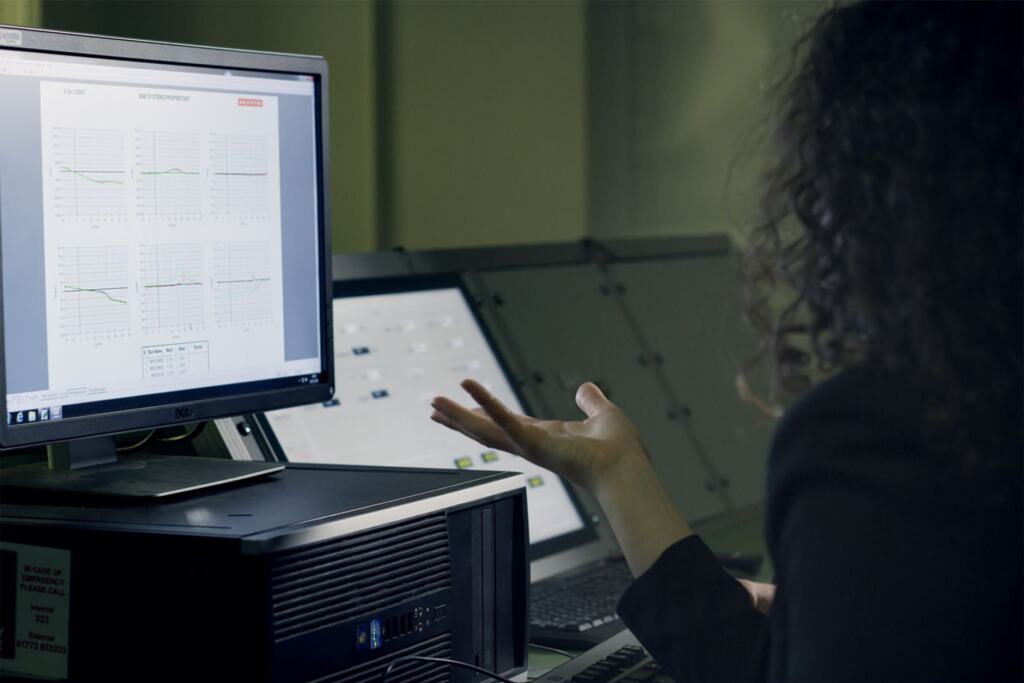
The scale of the later round shows how seriously the community treats the test. According to the CASP15 prediction centre, nearly 100 groups submitted more than 53,000 models on 127 modeling targets in 5 prediction categories in 2022.
Reading accuracy claims sensibly
- Compare with the baseline. A score over 90 means more when set beside the earlier ceiling of about 60 than it does on its own.
- Keep the scope in mind. The “largely solved” verdict was made for single protein chains, so it is not a blanket statement about every protein system.
- Prefer independent checks. Competition scores are one line of evidence; laboratory validation, covered below, is another.
Leading models compared
AlphaFold, from DeepMind, set the benchmark, but it is no longer the only deep-learning predictor in the competition. The comparison below uses the public CASP record, which is the fairest common yardstick available.
| Model or family | CASP record | Planning use |
|---|---|---|
| AlphaFold2 | CASP14 (2020): GDT_TS over 90, against about 60 for earlier overall accuracy | Sensible first choice for single-chain targets; check per-region reliability before using the model |
| RoseTTAFold | Deep-learning predictor listed by CASP organisers alongside AlphaFold since CASP14 | Useful as a second opinion; compare its output with AlphaFold on the same sequence |
| Modified or customised AlphaFold2 | All top performers in CASP15 (2022) used such versions | Shows the strongest results extend AlphaFold2 rather than replace it |
The entries draw on the EMBL-EBI course and the CASP15 overview.
One caution on reading the table: it does not rank RoseTTAFold against AlphaFold2 with a head-to-head score, and you should not infer one. If the choice matters for a project, run both on the target and compare them, rather than picking on reputation alone.
Checking predictions and using them in research
Validation of AlphaFold2 has gone well beyond the competition. EMBL-EBI lists studies using X-ray crystallography, cryogenic electron microscopy and cross-linking mass spectrometry. Solution NMR data suggested an excellent fit with the models in the vast majority of cases, and cross-linking mass spectrometry showed that the majority of predictions were correct, including for complexes studied in situ (EMBL-EBI).
Drug discovery and structure determination
The best-documented practical role is as a starting model for experiments: AlphaFold2 structures work well as search models for molecular replacement in X-ray crystallography. That shortens one stage of determining a structure, which is often the entry point for structure-based design. A predicted structure is still a hypothesis about a target, and a candidate that emerges from it faces the later experimental and human studies described in the research methods hub, where readers asking how do clinical trials work will find the next stage.

Prediction also sits alongside wet-lab model systems. For the hands-on side of that work, see How To Make Organoids: A Practical Lab Guide For Beginners (2026) – Biolifetechnologies.
Limitations to plan around
- Scope of the success. The “largely solved” verdict applies to single protein chains, so treat other settings as open questions to verify experimentally.
- Metric quirks. GDT_TS magnitudes depend on the size of the evaluated protein, so compare scores between similar targets rather than across very different ones.
- Dependence on solved structures. AlphaFold2 learned from experimentally established PDB structures, a small fraction of known sequences, so the quality of its predictions rests on what experiments have already revealed.
- Uneven reliability. The per-region scores exist because some parts of a prediction are more trustworthy than others, and a single good overall score can hide a weak region.
What comes next
CASP continues every two years, so the field keeps a public, blind record of progress. The CASP15 result, where every top performer used modified or customised AlphaFold2, suggests near-term gains will come from refining that architecture and its inputs. For projects, the practical direction is to pair predictions with experimental checks and keep an eye on each new CASP round for changes in the leading methods.
Frequently asked questions
| Question | Answer |
|---|---|
| What does a GDT_TS score measure? | It compares a predicted structure with the experimental one, on a scale from 0 for complete mismatch to 100 for perfect superimposition, and its magnitude depends on protein size (Frontiers). |
| Is AlphaFold the only deep-learning predictor? | No. CASP organisers name RoseTTAFold as a deep-learning method used alongside AlphaFold since CASP14 (CASP15). |
| Is CASP really blind? | Yes. It is double blinded: participants have no access to the experimental structures, and assessors do not know who submitted each model (Frontiers). |
| Has AlphaFold won major recognition? | Yes. The 2023 Albert Lasker Basic Medical Research Award honoured Hassabis and Jumper of DeepMind for the invention of AlphaFold (Lasker Foundation). |